Arabica Coffee Beans: The Complete Guide (2024)
If you’ve ever bought a bag of coffee and noticed “100% Arabica” on the label, you might have wondered what that actually means. Is it just marketing? Is it really better?
Short answer: yes, there’s a real difference — and it’s a big one.
Quick facts: Arabica (Coffea arabica) makes up 60–70% of all coffee produced globally. It has lower caffeine than Robusta (~1.2% vs ~2.7%), more sugar and fats, and is the foundation of specialty coffee worldwide. Originally from Ethiopia, now grown across Latin America, Africa, and Asia.
Arabica beans make up roughly 60–70% of all coffee produced in the world. They’re the reason specialty coffee exists, and they’re what most good coffee shops use. This article covers everything worth knowing about them — where they come from, how they grow, what they taste like, and how they compare to other beans.
Where Arabica Coffee Actually Comes From
Arabica coffee (Coffea arabica) originally comes from Ethiopia. The plant grew wild in the forests of the southwestern highlands, in a region called Kaffa — which is likely where the word “coffee” comes from.
The most famous story involves a goat herder named Kaldi, who noticed his goats acting unusually energetic after eating red berries from a certain tree. He tried them himself, felt great, and the rest is history. Whether or not that’s literally true, we know that Ethiopians were consuming coffee in some form as far back as the 9th or 10th century.
From Ethiopia, the plant traveled to Yemen, where people began cultivating it and brewing it as a drink. By the 15th century, coffeehouses had spread across the Arabian Peninsula — which is why it’s called Arabica. It was the coffee known to the Arab world.
From there, traders and explorers brought it to Europe, and eventually to Latin America, Asia, and beyond. Today, Brazil is the world’s largest Arabica producer by a wide margin.
What Makes Arabica Different from Other Coffee Beans
There are several species of coffee, but the two that matter for most people are Arabica and Robusta. Here’s how they actually differ:
| Arabica | Robusta | |
|---|---|---|
| Caffeine | ~1.2% | ~2.7% |
| Flavor | Sweet, complex, fruity or chocolatey | Stronger, more bitter, earthy |
| Sugar content | Higher | Lower |
| Fat content | Higher | Lower |
| Growing altitude | 600–2000m | Sea level to 800m |
| Disease resistance | Low | High |
| Price | Higher | Lower |
The lower caffeine in Arabica is part of why it tastes milder and less bitter. Caffeine is naturally bitter, so less of it means a smoother cup. The higher sugar and fat content contribute to the rounded, sweet flavors you get from a well-made Arabica espresso or pour-over.
Robusta isn’t bad — it has its uses, especially in espresso blends where you want strong body and thick crema. But if you’re drinking a quality filter coffee or specialty espresso, it’s almost certainly Arabica.
What Arabica Coffee Tastes Like
This is where things get interesting, because Arabica isn’t just one flavor. It’s more like a family of flavors that varies a lot depending on where the beans were grown.
In general, you can expect:
- Fruity notes — berries, citrus, stone fruit (common in Ethiopian and Kenyan Arabica)
- Chocolate and nutty tones — frequently found in Brazilian and Colombian beans
- Caramel and sweetness — a lot of Central American Arabicas land here
- Floral and tea-like — some high-altitude East African beans, especially Ethiopian naturals
Flavor in coffee is shaped by altitude, soil, climate, and processing method. Two bags of Arabica from different countries can taste remarkably different — which is exactly what makes exploring it so interesting.
One thing most Arabicas share: a clean, bright finish that Robusta just doesn’t have. The overall experience is more nuanced, and the aftertaste is more pleasant.
How and Where Arabica Grows
Arabica is a fussy plant. It needs the right conditions to produce good coffee, and it doesn’t handle stress well.
Altitude is probably the most important factor. Arabica thrives at elevations between 600 and 2,000 meters. Higher altitude means cooler temperatures, which slows the maturation of the coffee cherry. That slower process gives sugars and flavor compounds more time to develop. It’s why “high altitude” is often used as a quality signal on coffee bags — it usually means better flavor.
Temperature ideally stays between 15–24°C (59–75°F). Frost kills the plants. Too much heat causes problems with ripening and increases pest pressure.
Rainfall should be around 1,200–2,200mm per year, but the pattern matters. A distinct dry season helps trigger flowering and synchronizes the harvest cycle.
Soil quality matters too. Volcanic soils are particularly good — fertile, well-draining, rich in minerals. Many great coffee regions (Guatemala, Ethiopia, Kenya, Hawaii’s Kona coast) sit on or near volcanic land.
The major Arabica-producing countries today:
- Brazil — largest producer in the world, often at lower altitudes with a milder flavor profile
- Colombia — well-balanced, smooth beans, harvested twice a year due to two rainy seasons
- Ethiopia — the birthplace of the plant, produces some of the most complex and varied cups in the world
- Honduras — now Central America’s biggest producer
- Guatemala — known for regions like Antigua and Huehuetenango, with beans that range from chocolatey to bright and fruity
- Kenya — produces bold, berry-forward coffees that are among the most sought-after globally
- Indonesia — Sumatra and Java produce earthy, full-bodied Arabica with lower acidity
See our full guide to coffee bean types for more details on each origin.
How Arabica Is Harvested
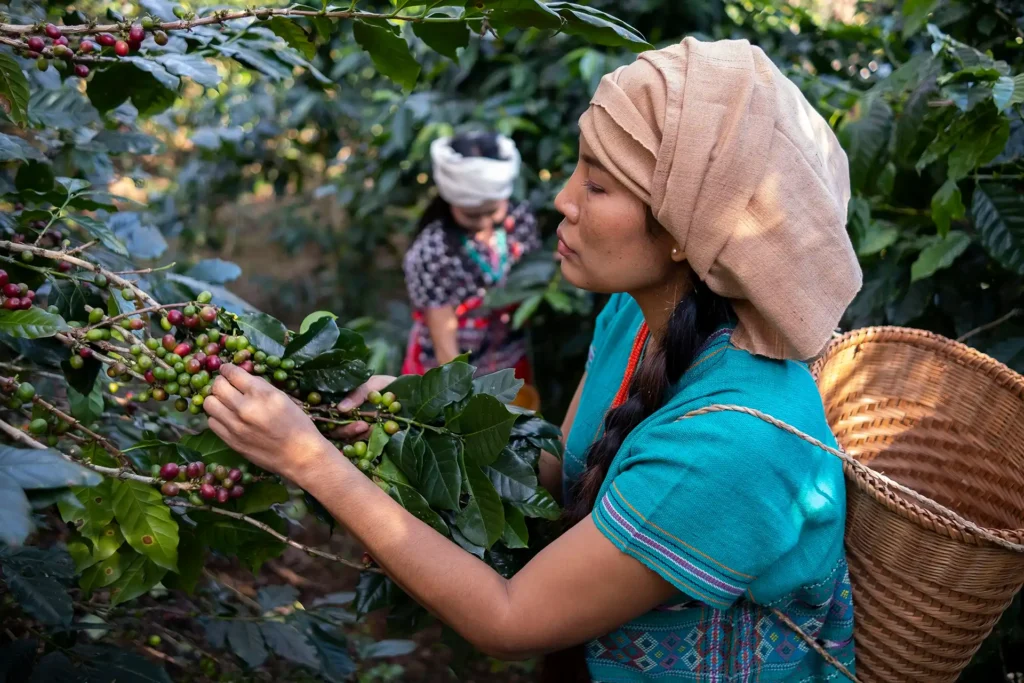
Most Arabica is still harvested by hand, especially in steep or mountainous regions. Workers walk through rows of trees and pick only the ripe cherries — usually red or deep purple — leaving the green ones to mature. This is called selective picking, and it’s labor-intensive but produces much better results than strip harvesting (where everything gets pulled off at once regardless of ripeness).
After picking, the cherries go through one of several processing methods:
- Washed (wet) process — fruit is removed quickly and beans are dried on raised beds. Produces clean, bright, high-clarity flavors. Common in Kenya, Colombia, and most of Central America.
- Natural (dry) process — whole cherries are dried in the sun for weeks before the fruit is removed. Creates more fruity, fermented, complex flavors. Very common in Ethiopia and Brazil.
- Honey process — a middle ground where some of the fruit pulp is left on the bean during drying. Results vary, but often gives a sweet, syrupy body.
The processing method can change the flavor of the coffee dramatically — sometimes as much as the origin itself.
The Main Varieties of Arabica
Within the Arabica species there are dozens of varieties (cultivars). The two original ones are Typica and Bourbon, and most modern varieties trace back to one or both of them.
A few worth knowing:
- Typica — one of the oldest cultivated forms. Excellent cup quality but low yields. Rare to find now.
- Bourbon — a natural mutation of Typica with slightly higher yields and a reputation for sweetness. Named after the island of Réunion, formerly called Bourbon.
- Gesha (Geisha) — originally from Ethiopia, famous since a 2004 competition in Panama. Incredibly delicate and floral, with jasmine and tea-like notes. Can be very expensive.
- SL28 / SL34 — Kenyan varieties bred for disease resistance in the 1930s–40s. Responsible for Kenya’s distinctive blackcurrant and citrus flavors.
- Caturra, Catuai, Mundo Novo — compact or high-yield varieties common in Brazil and Central America
When a specialty coffee roaster lists the specific variety on the bag, it’s usually a quality and transparency signal — they’re proud of exactly what they’re growing.
Threats Facing Arabica Coffee
Arabica has a real vulnerability problem. It’s genetically less diverse and more climate-sensitive than Robusta, which creates challenges.
Coffee leaf rust (Hemileia vastatrix) is a fungal disease that has devastated crops across Latin America, Asia, and Africa at multiple points in history. A major outbreak swept through Central America in 2012–2013, destroying significant portions of harvests in countries like Guatemala and Honduras and causing years of economic hardship for farming families.
Coffee berry borer is a tiny beetle that bores into coffee cherries and destroys the beans from inside. It’s considered the most economically damaging coffee pest worldwide.
Climate change is the biggest long-term concern. Rising temperatures and shifting rainfall patterns are making historically ideal growing regions less suitable for Arabica. A number of studies suggest that a significant share of current Arabica-growing land could become unsuitable by 2050 if warming trends continue. It’s a serious issue — both for coffee drinkers and for the hundreds of millions of people whose livelihoods depend on coffee farming.
Arabica vs Robusta: Which Should You Choose?
It depends entirely on what you’re making.
For filter coffee, pour-over, or Aeropress — 100% Arabica is almost always the right call. You want the clarity and complexity to come through, and Arabica delivers that.
For espresso — a small percentage of Robusta can actually improve things. It adds body, reduces sourness, and creates a thicker crema. Many Italian espresso traditions specifically use blends with 10–30% Robusta. It’s not a compromise, it’s a deliberate choice.
For instant coffee — most of what you’re getting is Robusta. It’s cheaper, has more caffeine, and holds up better to the manufacturing process.
The main point: “100% Arabica” is a real quality claim, not just marketing. But within Arabica, there’s enormous variation. A cheap supermarket Arabica blend tastes very different from a single-origin Ethiopian natural from a specialty roaster — even though both are technically “100% Arabica.” Origin, variety, processing, roast level, and freshness all play a role.
A Few Quick Facts
- Arabica has 44 chromosomes (Robusta has 22). It’s naturally allotetraploid — it evolved from a cross between two other coffee species, which contributes to its genetic complexity.
- A coffee tree takes 3–5 years to produce its first full harvest.
- Each tree yields roughly 1–1.5 kg of coffee beans per year — barely enough for one quality bag.
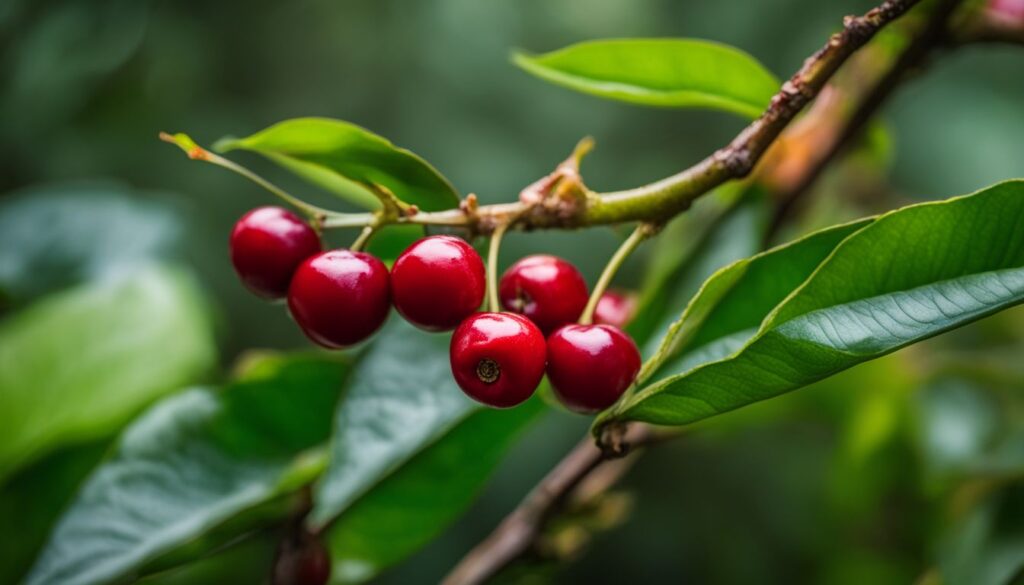
- Coffee cherries are typically red or yellow when ripe, depending on the variety.
- The name “Arabica” doesn’t mean the beans come from Arabia. It refers to the Arabian Peninsula’s role as the early hub of the global coffee trade.
Final Thoughts
Arabica coffee beans are genuinely worth knowing about. They require more care to grow, they’re more vulnerable to disease and climate shifts, and they’re more expensive to produce — but the payoff is in the cup. The complexity, sweetness, and range of flavors you get from good Arabica is hard to replicate with anything else.
Whether you’re making a simple drip coffee in the morning or exploring single-origin pour-overs on weekends, you’re probably already drinking Arabica. Now you know a lot more about what’s actually in that bag.
Interested in going deeper? Check out our guide on Robusta coffee beans or browse all coffee bean articles.
Frequently Asked Questions
Is Arabica coffee better than Robusta?
For most brewing methods — yes. Arabica has more complex flavor, less bitterness, and a cleaner finish. That said, Robusta has its place: it’s often used in espresso blends to add body and create thicker crema, and it has nearly twice the caffeine. “Better” depends on what you want from your cup.
Why is Arabica more expensive than Robusta?
Arabica plants are harder to grow. They need specific altitudes, temperatures, and soil conditions, and they’re more vulnerable to disease and frost than Robusta. The harvest is mostly done by hand, and yields per tree are relatively low — around 1–1.5 kg of beans per year. All of that adds up to a higher price.
Does Arabica have less caffeine?
Yes. Arabica contains around 1.2% caffeine by dry weight, compared to about 2.7% for Robusta. If you’re sensitive to caffeine, Arabica is the gentler choice. If you want a stronger hit, a blend with some Robusta (or just more coffee) will do the job.
What does Arabica coffee taste like?
It depends on the origin and processing, but generally: sweet, smooth, and complex. You’ll often find notes of fruit (berries, citrus), chocolate, caramel, or nuts. Ethiopian Arabica tends toward fruity and floral. Brazilian is usually chocolatey and nutty. Kenyan Arabica is bold with blackcurrant-like brightness.
Where does the name “Arabica” come from?
Despite the name, Arabica coffee doesn’t originate in Arabia. The beans are native to Ethiopia. The name comes from the Arabian Peninsula, which served as the main hub for the early global coffee trade — Yemen was the first country to cultivate coffee commercially and export it worldwide.